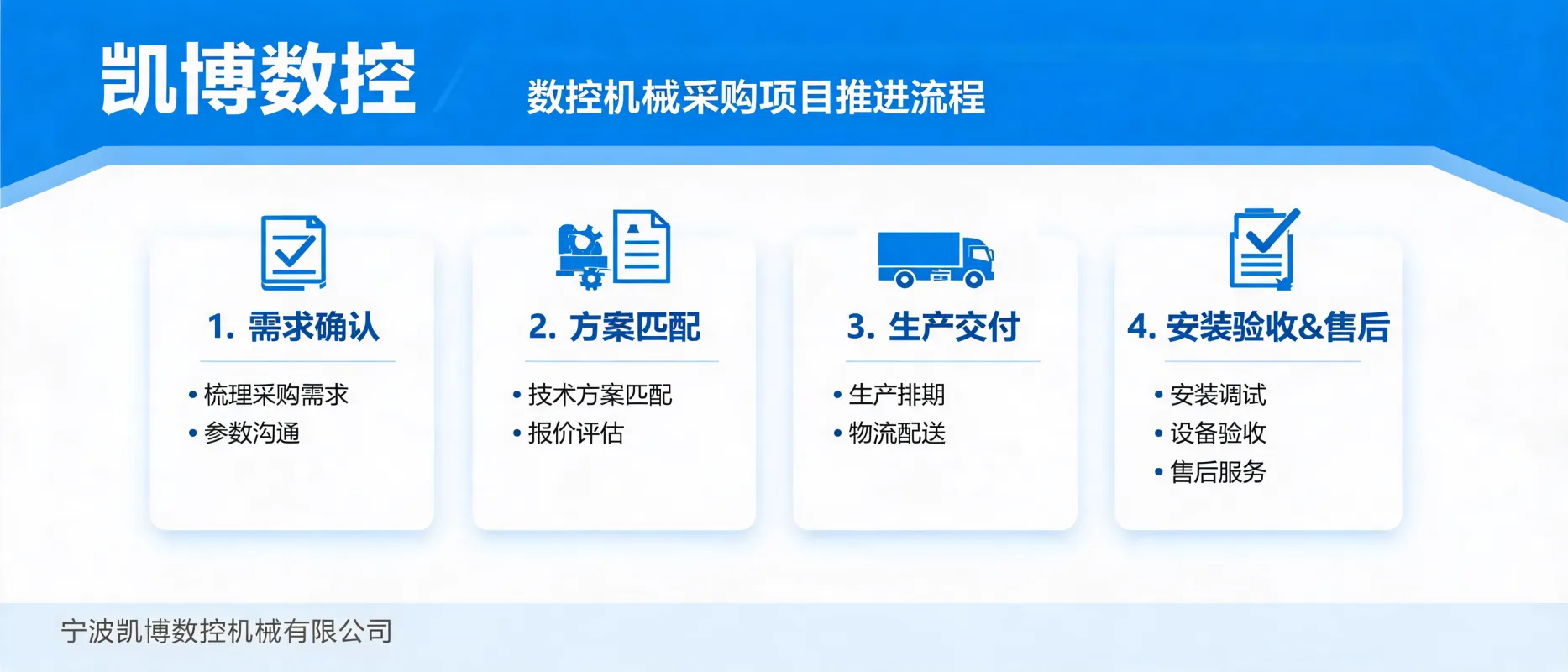
Purchasing a CNC machine is a long-term production decision, not simply a comparison of quoted prices. The right machine should support the parts you make, the processes you need, your operator capabilities, and the service resources available throughout the equipment’s working life.
Kaibo CNC helps B2B manufacturers approach CNC machine procurement with a clearer evaluation framework. For vertical machining centers, CNC engraving and milling machines, or customized CNC machine tools, buyers should assess operational fit, supportability, and total lifecycle value before making a decision.
Why Purchase Price Is Only One Part of CNC Machine Value
The initial machine price is visible and easy to compare. However, the real cost of ownership may also include installation preparation, tooling compatibility, operator training, maintenance, spare parts, production interruptions, and the machine’s ability to handle changing part requirements.
A lower upfront price may not represent better value if the selected CNC machine is poorly matched to the machining process or difficult to support after delivery. A structured procurement review helps manufacturing teams make decisions based on sustained production performance rather than a single purchase figure.
Eight Common CNC Machine Procurement Mistakes
1. Selecting a machine primarily by initial purchase price
A quotation comparison is necessary, but it should not become the only selection criterion. Machines with similar prices can differ in configuration, available options, commissioning support, service access, and suitability for the intended workload.
How to avoid it: Compare proposals against a shared technical and commercial checklist. Include machine configuration, expected process requirements, delivery scope, support arrangements, and foreseeable operating costs—not price alone.
2. Failing to define the actual machining process
Machine selection becomes uncertain when the buyer has not clearly identified workpiece materials, part dimensions, tolerance expectations, machining operations, fixture needs, and production volume. A machine that is capable in general terms may still be unsuitable for a specific production task.
How to avoid it: Prepare representative part drawings and process information before requesting a proposal. Discuss the primary operations, such as milling, drilling, engraving, multi-face machining, or more complex axis movement, with the machine supplier.
3. Choosing an unsuitable machine configuration
Travel range, spindle selection, tool capacity, control system, table design, axis arrangement, and optional functions influence how effectively a CNC machine can perform the planned work. Under-specification can limit production flexibility, while unnecessary configuration may add cost without meaningful process benefit.
How to avoid it: Match the configuration to current production requirements and realistic near-term development plans. For example, determine whether a 3-axis, 4-axis, or 5-axis vertical machining center is needed according to part geometry and setup strategy.
4. Overlooking tooling, fixtures, and workshop integration
A CNC machine operates as part of a production system. Toolholders, cutting tools, fixtures, material handling, power supply, compressed air, chip management, floor space, and operator access should be considered before purchase.
How to avoid it: Review site conditions and peripheral equipment requirements early. Confirm that the machine can be installed, supplied, operated, and maintained within the available workshop environment.
5. Treating after-sales service as an afterthought
Service capability is especially important when a machine supports critical production work. Buyers who focus only on machine specifications may not fully assess how installation guidance, technical communication, troubleshooting, and maintenance support will be handled after delivery.
How to avoid it: Ask practical questions before ordering: Who will provide technical support? What channels are available? What information is required for remote diagnosis? What support is available during commissioning and normal operation?
6. Not checking spare-parts availability and maintenance planning
Even well-maintained equipment may require replacement parts over time. If spare-parts planning is ignored, an otherwise manageable repair can create avoidable downtime and uncertainty.
How to avoid it: Discuss the recommended maintenance schedule, commonly replaced items, parts identification process, and spare-parts ordering procedure. Keep accurate machine records, including model, configuration, serial information, and service history.
7. Underestimating overseas service communication and response needs
For international CNC machine procurement, distance, time zones, language, logistics, and local technical resources can affect how efficiently service questions are addressed. This does not prevent successful equipment operation, but it should be evaluated as part of the purchase decision.
How to avoid it: Clarify communication methods, documentation language, remote support procedures, and the process for obtaining technical assistance or replacement components in your region.
8. Ignoring training, preventive maintenance, and lifecycle cost
A CNC machine’s long-term performance depends on appropriate operation, routine inspection, correct maintenance, and the ability of the team to use the control and process functions effectively. These factors influence productivity, equipment condition, and operational continuity over time.
How to avoid it: Include training and maintenance planning in the procurement project. Evaluate total lifecycle cost by considering the machine’s intended use, service needs, consumables, parts support, and the operational resources required after installation.


.png?x-oss-process=image/resize,h_100,m_lfit/format,webp)
.png?x-oss-process=image/resize,h_100,m_lfit/format,webp)
.png?x-oss-process=image/resize,h_100,m_lfit/format,webp)