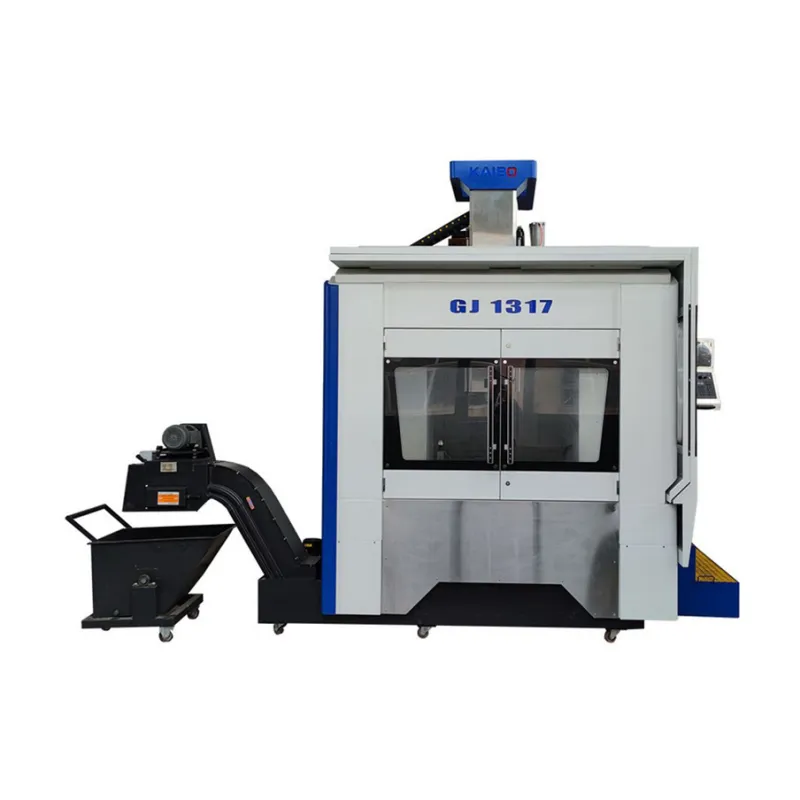
Purchasing a CNC machine is a process decision, not simply a comparison of quotations or specifications. A machine that appears competitive on initial price may not be the most suitable choice if its axis configuration, process capability, stability, support arrangement or operating requirements do not match the parts being produced.
For manufacturing buyers, a practical evaluation should connect the machine to actual workpieces, materials, tolerances, production volume, tooling and future process needs. Kaibo CNC recommends assessing CNC machine selection through the combined lens of application fit, machining stability and long-term operating value.
CNC machines are production assets whose value is determined during operation. Focusing on one factor—especially purchase price, nominal travel or the number of axes—can overlook requirements that affect setup time, repeatability, surface quality, cycle time and service continuity. The objective is not to select the machine with the longest specification list; it is to select a machine that supports the intended machining process reliably and efficiently.
A lower initial quotation does not by itself indicate lower ownership cost. Buyers should consider the machine configuration, included equipment, installation needs, tooling compatibility, energy and maintenance requirements, operator training and expected support access.
Three-, four- and five-axis machines serve different machining requirements. More axes can provide greater positioning flexibility and reduce certain setups, but they are not automatically necessary for every component. Conversely, an insufficient axis configuration may require repeated clamping or process compromises for complex surfaces and multi-face features.
Machine travels, table size and spindle-related requirements should be reviewed in relation to the workpiece and the actual cutting task. The type of material, fixture dimensions, tool reach, cavity depth, desired finish and chip removal conditions can all influence the appropriate machine configuration.
Machining stability affects consistency in daily production. It should be evaluated in the context of the intended workpiece, cutting parameters, toolpath, tooling, fixture and operating environment. A specification sheet alone cannot fully describe how a machine will behave in a specific production application.
Productivity is influenced by more than cutting time. Loading access, fixture design, tool changes, part orientation, datum strategy and operator handling can materially affect the efficiency of a machining cell. A machine should be reviewed as part of the complete production workflow rather than as an isolated unit.
Service planning is particularly important for B2B buyers operating across regions. Before placing an order, clarify communication channels, commissioning arrangements, documentation, spare-parts processes and the available support route for the installation location. Kaibo CNC states that it maintains sales and service offices in China and overseas; buyers should confirm the applicable support arrangement for their specific market and machine configuration.
| Evaluation area | Questions to clarify | Why it matters |
|---|---|---|
| Part requirements | What are the workpiece size, material, geometry, tolerance and finish requirements? | Defines the machine envelope and process capability needed. |
| Axis selection | How many faces, angles or complex contours must be machined in one setup? | Helps determine whether 3-, 4- or 5-axis machining is appropriate. |
| Process workflow | What fixtures, tools, loading methods and setup steps are required? | Supports a realistic view of production efficiency. |
| Stability expectations | What machining conditions and quality criteria are critical for the application? | Connects machine selection with repeatable production requirements. |
| Service readiness | Who will support installation, operation, maintenance and parts needs at the destination? | Reduces uncertainty after delivery and during operation. |
A clear technical brief helps suppliers recommend a configuration that is aligned with the intended application. Before discussing a CNC vertical machining center, CNC engraving and milling machine, or a customized CNC machine, prepare the following information where available:
A well-considered CNC machine purchase balances price, axis configuration, process compatibility, machining stability and service planning. Ningbo Kaibo CNC Machinery Co., Ltd. develops and manufactures 3-, 4- and 5-axis vertical machining centers, CNC engraving and milling machines, and customized CNC machine solutions. By sharing real application requirements early, manufacturing buyers can make a more informed comparison and identify a configuration that fits their production needs.
 Ningbo Kaibo CNC
overseas markets
CNC engraving and milling machine applications
customer service
customized adaptation
Kaibo CNC
3-axis machining center
4-axis machining center
5-axis machining center
selection guide
Ningbo Kaibo CNC Machinery Co., Ltd.
CNC engraving and milling machine
machine definition
precision machining
application scenarios
Ningbo Kaibo CNC Machinery Co., Ltd.
CNC engraving and milling machine selection
configuration approach
machining requirements
precision requirements
procurement decision
Ningbo Kaibo CNC Machinery Co., Ltd.
custom CNC machine tools
non-standard requirements
special workpiece machining
solution implementation
Ningbo Kaibo CNC
overseas markets
CNC engraving and milling machine applications
customer service
customized adaptation
Kaibo CNC
3-axis machining center
4-axis machining center
5-axis machining center
selection guide
Ningbo Kaibo CNC Machinery Co., Ltd.
CNC engraving and milling machine
machine definition
precision machining
application scenarios
Ningbo Kaibo CNC Machinery Co., Ltd.
CNC engraving and milling machine selection
configuration approach
machining requirements
precision requirements
procurement decision
Ningbo Kaibo CNC Machinery Co., Ltd.
custom CNC machine tools
non-standard requirements
special workpiece machining
solution implementation



.png?x-oss-process=image/resize,h_100,m_lfit/format,webp)
.png?x-oss-process=image/resize,h_100,m_lfit/format,webp)
.png?x-oss-process=image/resize,h_100,m_lfit/format,webp)