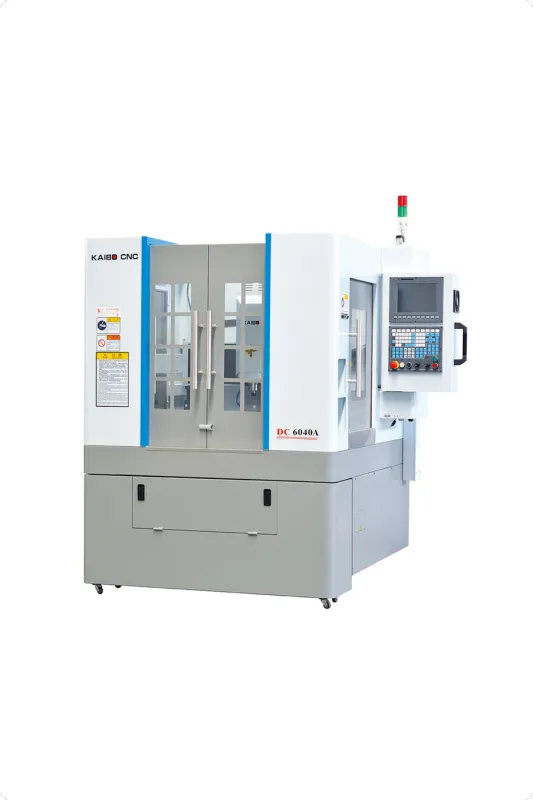
In today’s competitive manufacturing landscape, precision isn’t just a goal—it’s a requirement. For companies producing copper electrodes used in EDM (Electrical Discharge Machining), even minor deviations can lead to costly rework or rejected batches. That’s where the DC6050A Copper Electrode CNC Router steps in—not as another machine, but as a strategic upgrade that boosts productivity, reduces waste, and future-proofs your shop floor.
The DC6050A leverages high-resolution servo motors and advanced spindle control systems to achieve ±0.01mm repeatability—far beyond what traditional manual milling tools offer. In one case study with an automotive parts manufacturer in Germany, after integrating the DC6050A into their electrode production line, they reported a 42% reduction in scrap rate within three months. Their average surface finish improved from Ra 3.2μm to Ra 1.5μm—a critical improvement for EDM accuracy.
Where older machines took 45 minutes per complex electrode, the DC6050A completes the same task in under 25 minutes—with no loss in quality. This translates to a 44% faster cycle time, allowing shops to handle more jobs per shift without adding staff or overtime. One electronics OEM in the U.S. saw output rise from 120 units/week to 175 units/week after implementation—without investing in new personnel.
Key Performance Comparison:
| Feature | Traditional Milling | DC6050A CNC Router |
|---|---|---|
| Cycle Time (per part) | 45 min | 23 min |
| Surface Finish (Ra μm) | 3.2 | 1.5 |
| Scrap Rate Reduction | Baseline | ↓42% |
Unlike many “next-gen” machines that require extensive training or process overhauls, the DC6050A was designed for plug-and-play compatibility. With support for standard G-code and intuitive HMI interface, operators who previously worked on older mills transitioned smoothly in less than two days. A Chinese mold-making factory noted a 90% drop in downtime during integration compared to past equipment upgrades.
A mid-sized tooling supplier in Dubai shared how the DC6050A helped them win a contract with a major aerospace client requiring ultra-fine tolerance electrodes. “Before this machine,” said their operations manager, “we were losing bids because we couldn’t consistently hit Ra 1.5. Now we’re not just meeting specs—we’re exceeding them.”
 Graphite Electrode
Market Analysis
Industry Trends
Electrode Production
Graphite Market
CNC milling machine
vertical machining center
belt-type spindle
manufacturing technology
machining precision
4-axis CNC milling machine DC8070A
automatic tool change CNC milling machine
small and medium-sized processing center solutions
DC6050A
CNC engraving milling machine
common issues
solutions
high-precision machining
["DC6060A CNC Milling Machine"
"BT30 Spindle Performance"
"High Precision Milling Equipment"
"Rigid CNC Milling Solutions"
"Small CNC Machine Comparison"]
Graphite Electrode
Market Analysis
Industry Trends
Electrode Production
Graphite Market
CNC milling machine
vertical machining center
belt-type spindle
manufacturing technology
machining precision
4-axis CNC milling machine DC8070A
automatic tool change CNC milling machine
small and medium-sized processing center solutions
DC6050A
CNC engraving milling machine
common issues
solutions
high-precision machining
["DC6060A CNC Milling Machine"
"BT30 Spindle Performance"
"High Precision Milling Equipment"
"Rigid CNC Milling Solutions"
"Small CNC Machine Comparison"]







.png?x-oss-process=image/resize,h_100,m_lfit/format,webp)
.png?x-oss-process=image/resize,h_100,m_lfit/format,webp)
.png?x-oss-process=image/resize,h_100,m_lfit/format,webp)